
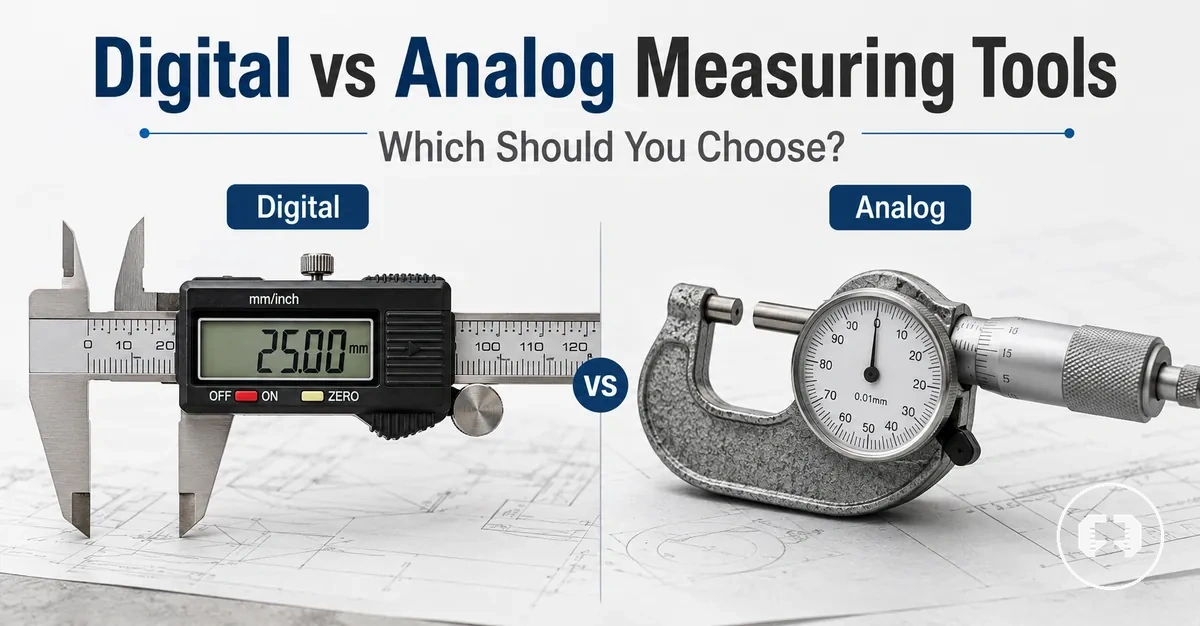
Digital vs analog precision measuring tools
Digital vs analog precision measuring tools depend on the measurement task, reading preference, workshop conditions, tool quality, calibration state, and long-term use rather than on one system being universally better.
Digital and analog describe differences in reading method and measurement mechanism, not complete tool categories by themselves. The broader precision measuring tools hub connects these systems to tool types, measurement roles, and selection criteria.
Digital precision measuring tools use a digital display to present a readable value, which can support faster readings, unit switching, and easier interpretation when the tool is properly calibrated and suitable for the task. Analog precision measuring tools use a vernier scale, dial reading, or other mechanical system, which can support no-power operation and direct scale interpretation when the user can read the scale accurately.
The main comparison is digital convenience versus analog simplicity. Accuracy, resolution, repeatability, durability, and overall reliability depend on calibration, tool quality, measurement technique, power conditions where applicable, and the intended use, so the more suitable choice varies with the application rather than the display style alone.
How digital and analog precision measuring systems differ
A digital measuring system uses an electronic signal and a digital display, while an analog measuring system uses mechanical movement with an analog scale, vernier scale, or dial reading. The key difference is the measuring system and readout method rather than overall measurement capability.
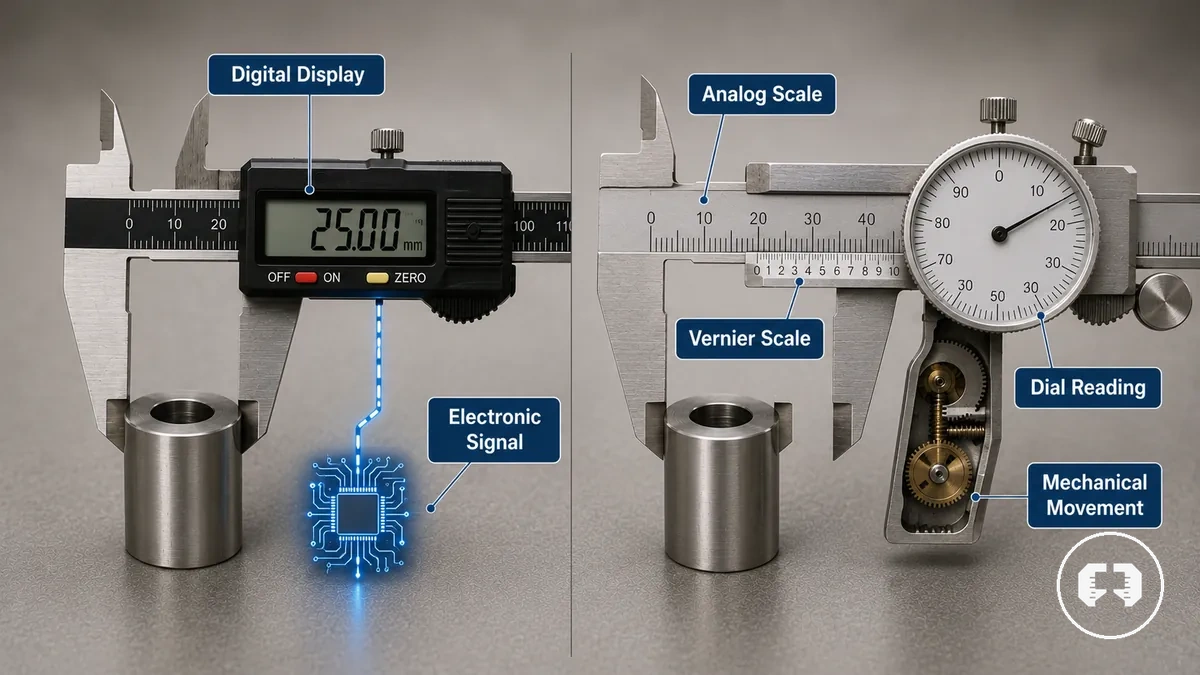
Digital and analog systems differ in user interaction and reading condition because the user either reads a displayed value or interprets a scale or pointer. Both digital and analog tools can provide precise measurements when they are well made, properly calibrated, and used correctly, so the readout and mechanism are more consistent comparison points than overall performance.
The table below compares the core system characteristics before later sections discuss accuracy, durability, and selection criteria in greater detail.
| Comparison point | Digital measuring system | Analog measuring system |
|---|---|---|
| Readout | Digital display | Analog scale, vernier scale, or dial reading |
| Signal type | Electronic signal | Mechanical movement |
| User interaction | Reads the displayed value directly | Interprets scale graduations or pointer position |
| Reading condition | Can make values quicker to interpret | Depends more on clear scale reading and user interpretation |
| Effect on speed and reliability | Readout may reduce interpretation time | Readout depends more on consistent visual interpretation |
Digital displays and electronic measurement signals
A digital display converts an electronic measurement signal into a readable value that the user can interpret directly. The digital display presents the measured result, while the measurement itself still depends on proper tool contact and calibration rather than the display alone. Features such as a zero function and unit switching can improve convenience without automatically increasing measurement accuracy.
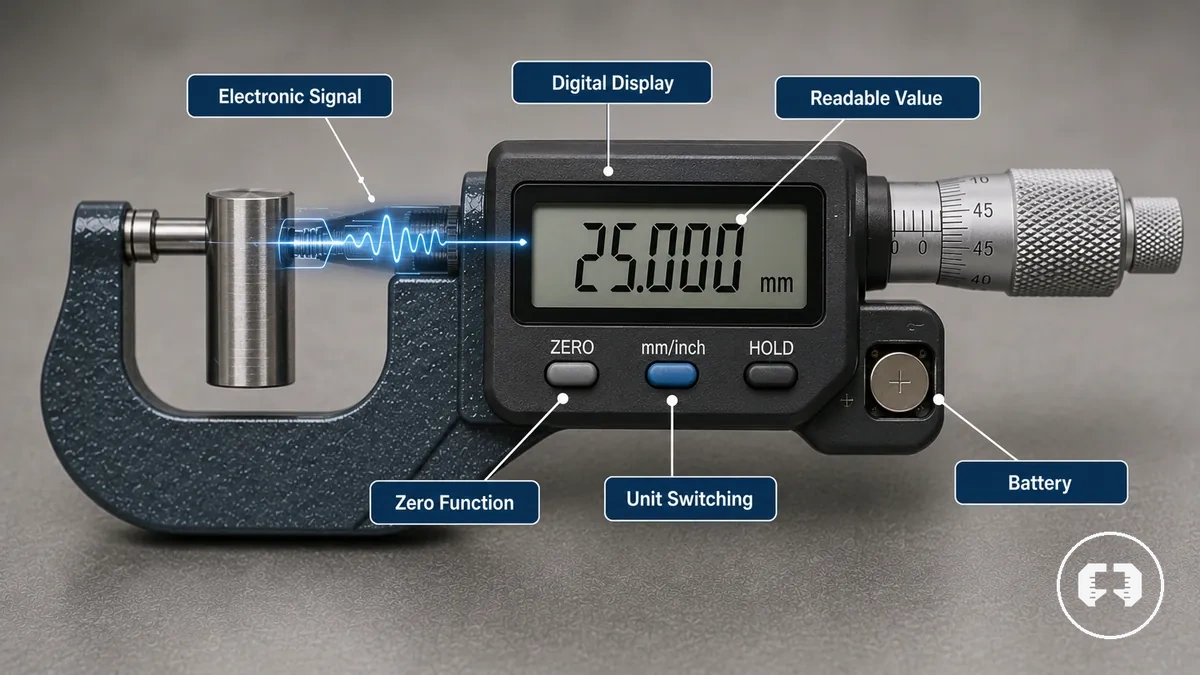
A digital tool may make values quicker to read because the display reduces the need to interpret scale markings, although readability can vary with battery condition, display lag, and operating conditions. Convenient readout should not be confused with measurement accuracy, which continues to depend on calibration and consistent tool contact.
- Zero function: Sets a reference point to simplify relative measurements.
- Unit switching: Changes the displayed measurement unit without changing the measured dimension.
- Battery: Powers the electronic measurement signal and digital display, so low battery may affect display availability.
- Readable value: A digital display can reduce reading effort while reliable results still depend on correct measurement technique.
Vernier scales, dial readings, and mechanical measurement signals
Vernier scales and dial readings are analog measurement systems that communicate values through a mechanical scale instead of an electronic display. A vernier scale requires scale interpretation by aligning graduations, while a dial reading uses a pointer that moves across a mechanical scale. The scale-reading method matters because it influences how the measured value is interpreted.
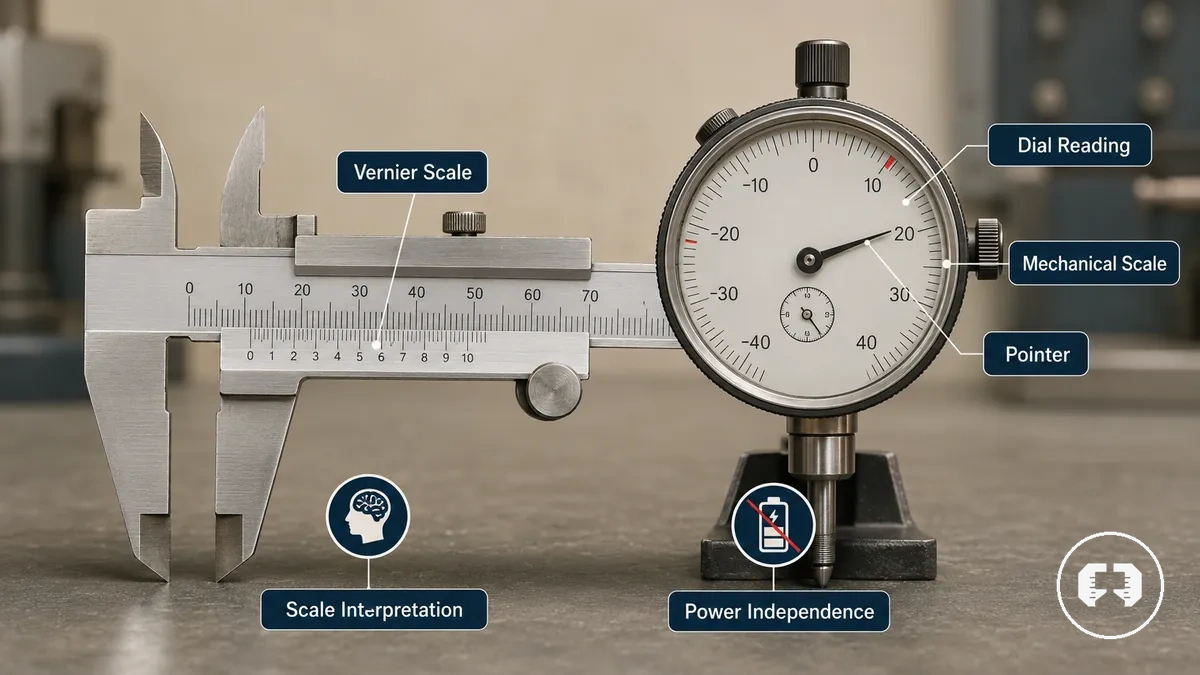
Vernier scales and dial readings are both analog forms, but they create different reading experiences. A dial reading may allow quicker visual interpretation, while a vernier scale usually relies more on careful scale interpretation. Analog tools provide power independence because their mechanical measurement signal does not rely on a battery, although reading ease and the likelihood of user error can vary with lighting, viewing angle, scale condition, and reading skill.
| Analog reading method | Reading characteristic |
|---|---|
| Vernier scale | Requires careful scale interpretation by aligning graduations. |
| Dial reading | Uses a pointer for quicker visual interpretation of the mechanical scale. |
Accuracy, resolution, and repeatability differences
Display type alone does not determine measurement quality. Accuracy, resolution, repeatability, calibration state, user technique, and tool quality together influence the real measurement outcome, so a digital readout or analog scale should not be treated as an automatic accuracy advantage.
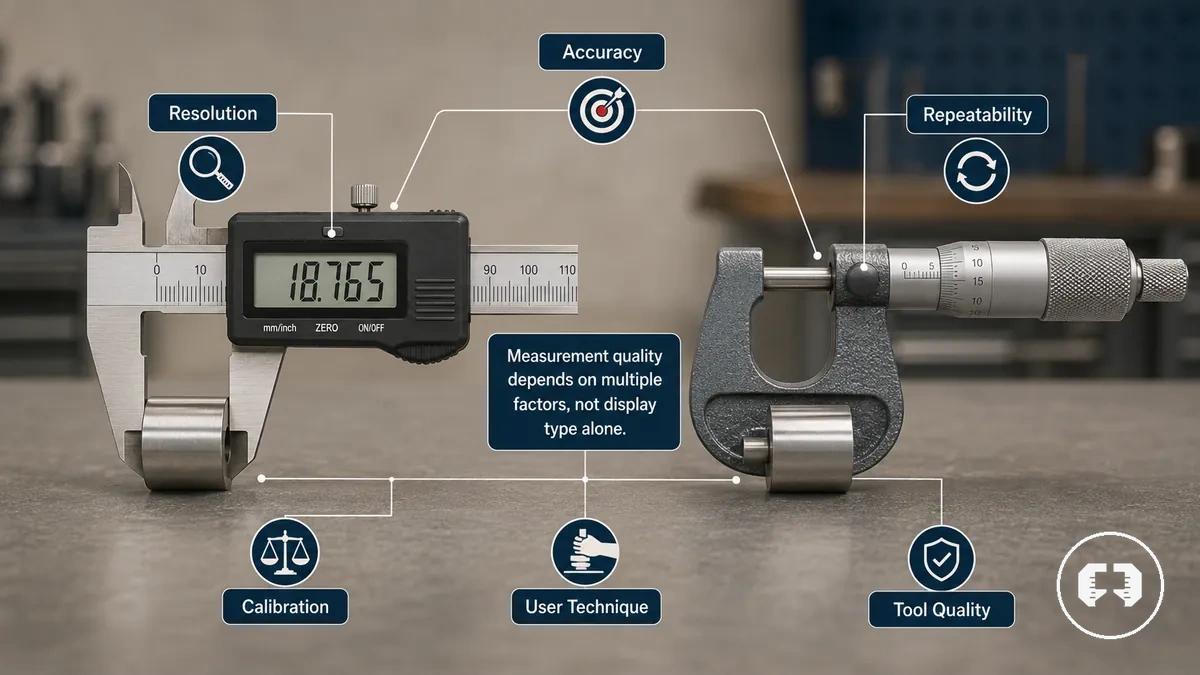
Accuracy describes how closely a measurement matches the intended value, while resolution describes the smallest change that the tool can display or indicate. Repeatability describes how consistently the tool can produce similar results under similar conditions. For a broader explanation of these criteria, see accuracy and resolution differences.
Higher resolution may make a reading easier to distinguish, but it does not automatically improve true accuracy or repeatability. Real measurement quality depends on calibration state, user technique, tool quality, and suitable measurement conditions, especially when a measurement must fit a tolerance or be repeated with confidence.
| Criterion | What it indicates | Effect on measurement quality |
|---|---|---|
| Accuracy | Closeness of the measured value to the intended value | Supports confidence when measurements must meet tolerance requirements |
| Resolution | Smallest displayed or indicated measurement change | May improve reading detail without increasing true accuracy |
| Repeatability | Consistency of repeated measurements under similar conditions | Supports reliable comparison between repeated measurements |
| Calibration state and user technique | Condition of the tool and how it is used | Influence the real measurement outcome regardless of display type |
Readability, speed, and user error risk
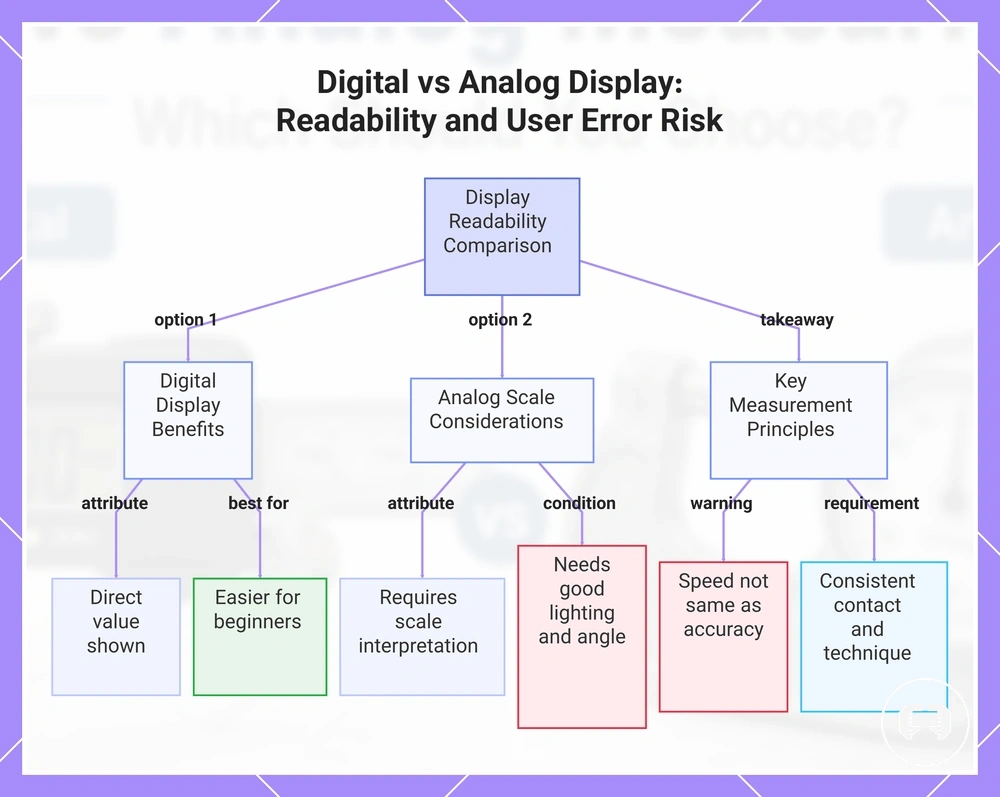
Readability influences both reading speed and the likelihood of user error. A digital display may reduce interpretation effort, while an analog scale relies more on scale interpretation, so the easier reading method depends on user experience, lighting, viewing angle, and the measurement task rather than on display type alone.
Beginners often find a digital display easier to interpret because the measured value is shown directly, while experienced users may work confidently with either system. During repeated measurements, quicker value recognition may support a faster workflow, whereas careful one-off measurements can still suit an analog tool when the scale is clear and the reading is taken deliberately.
Reading quickly is not the same as measuring correctly. Consistent tool contact, suitable viewing conditions, and careful reading technique remain important regardless of display style. If you want to learn the reading methods themselves, see reading digital and analog scales.
- Choose a reading method that matches your experience and working conditions.
- Good lighting and a suitable viewing angle can make analog scale interpretation easier.
- Clear display readability may reduce interpretation effort during repeated measurements.
- Careful measurement remains important when working to close tolerances, regardless of display type.
- If inconsistent readings occur, review common measuring tool errors to identify possible reading and handling issues.
This chart compares digital and analog displays in terms of readability, user error risk, and suitability based on user experience and measurement conditions.
Reliability, power needs, and workshop conditions
Reliability depends on workshop conditions as well as the measuring system. Power needs, moisture exposure, dust, impact, storage, and calibration condition can all influence reading confidence and maintenance needs, so neither digital nor analog measuring tools are inherently more reliable in every environment.
Digital measuring tools rely on battery power and electronic components, which means power availability and operating conditions can affect continued use. When batteries are maintained, the tool is stored appropriately, and calibration remains suitable, a digital tool can provide dependable operation with minimal downtime. Moisture, dust, or impact may increase the need for inspection or maintenance, depending on the tool and its design.
Analog measuring tools do not require battery power, but their reliability still depends on calibration condition, careful storage, and protection from wear or damage. Mechanical systems can continue to operate without a power source, yet reading confidence may still decrease if the scale, pointer, or measuring mechanism becomes worn, contaminated, or misaligned.
| Workshop condition | Digital measuring tools | Analog measuring tools |
|---|---|---|
| Power needs | Depends on battery availability | Does not require battery power |
| Moisture and dust | Protection and maintenance may influence reliability | Mechanical components may also require protection and cleaning |
| Impact and storage | Careful handling can help maintain reliability | Careful handling can help maintain mechanical condition |
| Calibration condition | Influences reading confidence and potential downtime | Influences reading confidence and potential downtime |
Battery dependence and electronic failure points
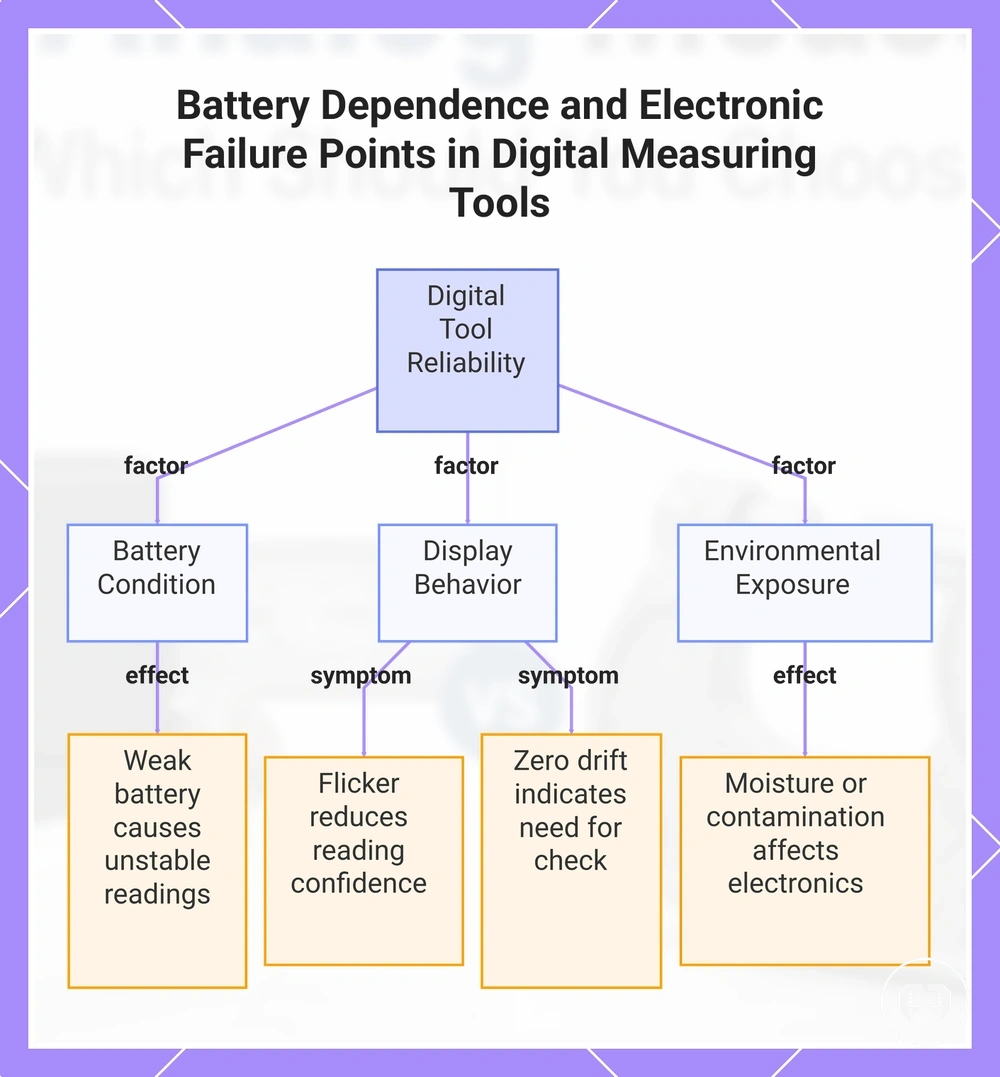
Battery dependence can create local reliability limits in digital measuring tools when visible signs indicate that the electronic system is no longer operating normally. Low battery condition, unstable display behavior, moisture exposure, or contamination may reduce reading trust or interrupt work, but these conditions do not replace normal calibration checks or mean that electronic faults are inevitable.
Digital components and display behavior should be considered together because reading confidence depends on stable electronic operation as well as correct measurement technique. If visible display changes or unusual readout behavior appear after battery depletion or environmental exposure, the tool should be checked before relying on further measurements.
- Low battery: A weak battery may cause unstable readings or reduced display reliability.
- Display flicker: Intermittent display behavior may reduce reading confidence and interrupt work.
- Zero drift: A changing zero reference may indicate that the tool should be checked before further measurements.
- Moisture or contamination: Environmental exposure may affect electronic operation and reduce confidence in displayed readings.
This chart shows how battery condition, display behavior, and environmental factors affect reading reliability and when to check the tool.
Mechanical durability and no-power measurement use
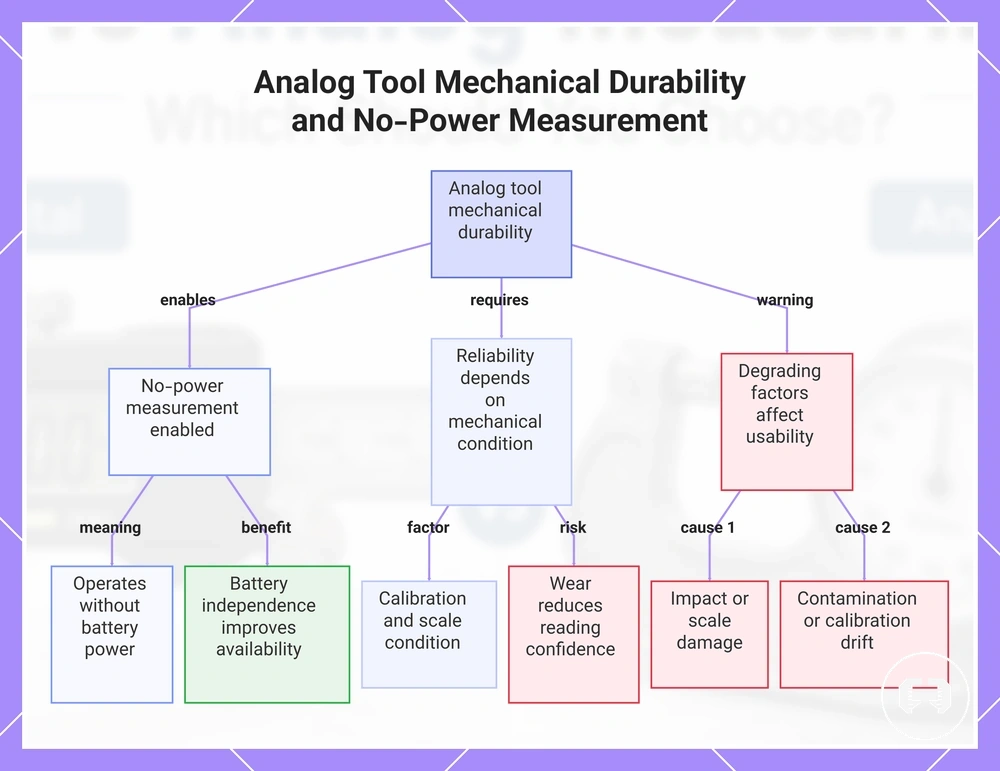
Mechanical durability allows analog measuring tools to operate without battery power, so no-power measurement remains available whenever the tool is mechanically functional. Battery independence improves availability, but measurement correctness still depends on calibration condition, scale condition, and the overall state of the analog mechanism rather than the absence of electronics alone.
Analog mechanisms can remain usable after long storage or during field work where battery replacement is impractical, but wear, impact, contamination, scale damage, and calibration drift may reduce reading confidence over time. No-power measurement supports continued use, yet reliable results still depend on mechanical condition and proper maintenance rather than mechanical durability alone.
- Wear: Mechanical wear may reduce reading confidence as moving components age.
- Impact or scale damage: Physical damage may affect usability and make readings less dependable.
- Contamination or calibration drift: Dirt or changing calibration condition may reduce measurement confidence until the tool is checked.
This chart shows how mechanical durability enables no-power measurement in analog tools and what factors still affect reading reliability.
Digital, vernier, dial, and mechanical tools compared
Choosing between digital, vernier, dial, and mechanical measuring tools depends on the preferred reading mechanism, measurement task, learning curve, and working conditions rather than on one tool family being universally better. Comparing the main tool families helps match the measuring system to the intended application while keeping the decision focused on practical tradeoffs.
Digital calipers, vernier calipers, dial calipers, and micrometers represent common precision measuring tool families with different reading mechanisms and task fit. For a broader overview beyond this comparison, see types of measuring tools.
| Tool family | Reading mechanism | Measurement role | Ease, durability, and learning curve | Decision tradeoff |
|---|---|---|---|---|
| Digital calipers | Electronic display | General precision measurement | Often easier to read, depends on battery power | May simplify reading but requires electronic operation |
| Vernier tools | Vernier scale | General precision measurement | Mechanical design with a longer learning curve | No battery required but accurate reading depends on scale interpretation |
| Dial tools | Mechanical dial and pointer | General precision measurement | Mechanical design with a moderate learning curve | No battery required but mechanical condition influences reading confidence |
| Micrometers | Mechanical or digital measuring system | High-precision dimensional measurement | Learning curve depends on the selected reading system | Selection depends on the measurement task and preferred readout |
Digital calipers vs vernier calipers
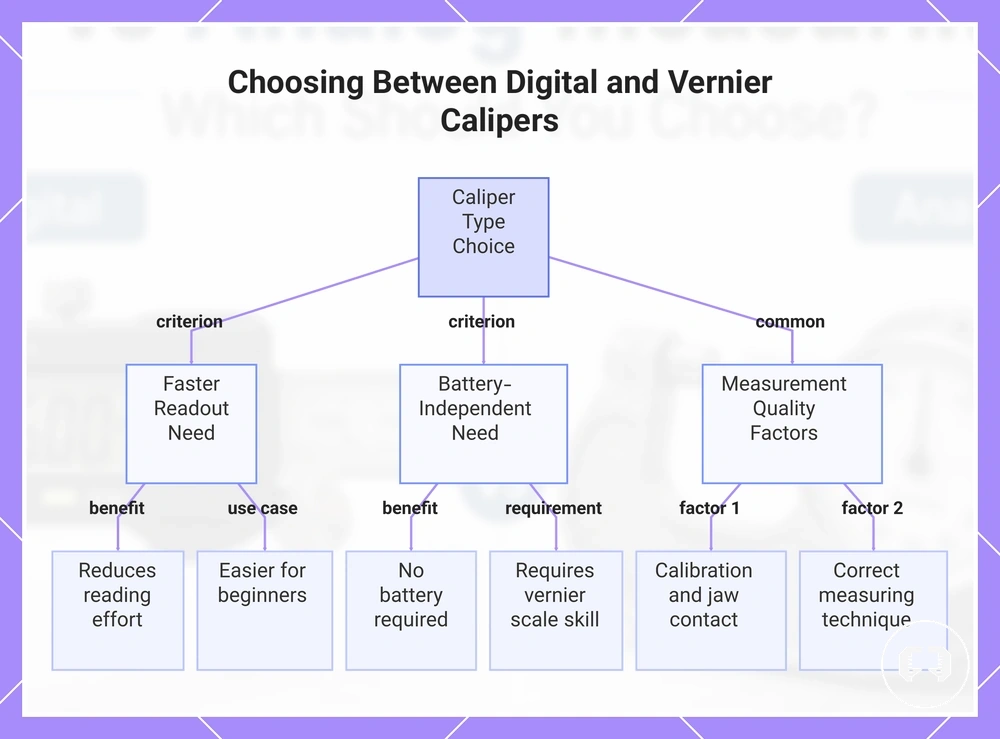
Choosing between a digital caliper and a vernier caliper depends on whether faster readout or battery-independent operation better suits the measurement task. A digital caliper may reduce reading effort during repeated measuring, while a vernier caliper relies on vernier scale reading skill and does not require battery power. For either type, measurement quality depends on calibration, proper jaw contact, and correct measuring technique rather than the readout alone.
Digital calipers may be easier for beginner use because the display reduces scale interpretation, whereas a vernier caliper may suit users who prefer no-power operation and are comfortable reading a vernier scale. The better choice depends on reading skill, measurement frequency, and working conditions instead of caliper type alone.
- Digital caliper + beginner use: The display may support quicker reading and repeated measuring with less scale interpretation.
- Vernier caliper + no-power need: The vernier scale works without a battery but requires greater reading skill.
- Digital or vernier caliper + measurement quality: Reliable measurements depend on calibration, proper jaw contact, and consistent measuring technique.
This chart shows the two main criteria for selecting a caliper type and the common factors that affect measurement quality.
Digital tools vs dial measuring tools
Choosing between digital tools and dial measuring tools depends on whether direct value capture or pointer-based visual feedback better suits the measurement task. Dial measuring tools are analog but may be easier for some users to read than vernier scales because the pointer shows movement continuously, while digital tools present measured values on a display. The preferred option depends on the measurement role, working conditions, and user preference.
Digital tools may support repetitive checking by reducing reading effort through direct value capture, whereas dial measuring tools can provide continuous pointer movement that may help with alignment and response behavior during adjustment tasks. Dial measuring tools are not interchangeable with digital tools because the measurement role, measuring mechanism, and user preference all influence which approach is more suitable for a given task.
| Digital tools | Dial measuring tools |
|---|---|
| Display presents measured values directly and may support quicker repetitive checking. | Dial reading uses a pointer that may provide clearer visual feedback during alignment. |
| May suit users who prefer direct value capture. | May suit users who prefer pointer movement instead of scale interpretation. |
Digital micrometers vs mechanical micrometers
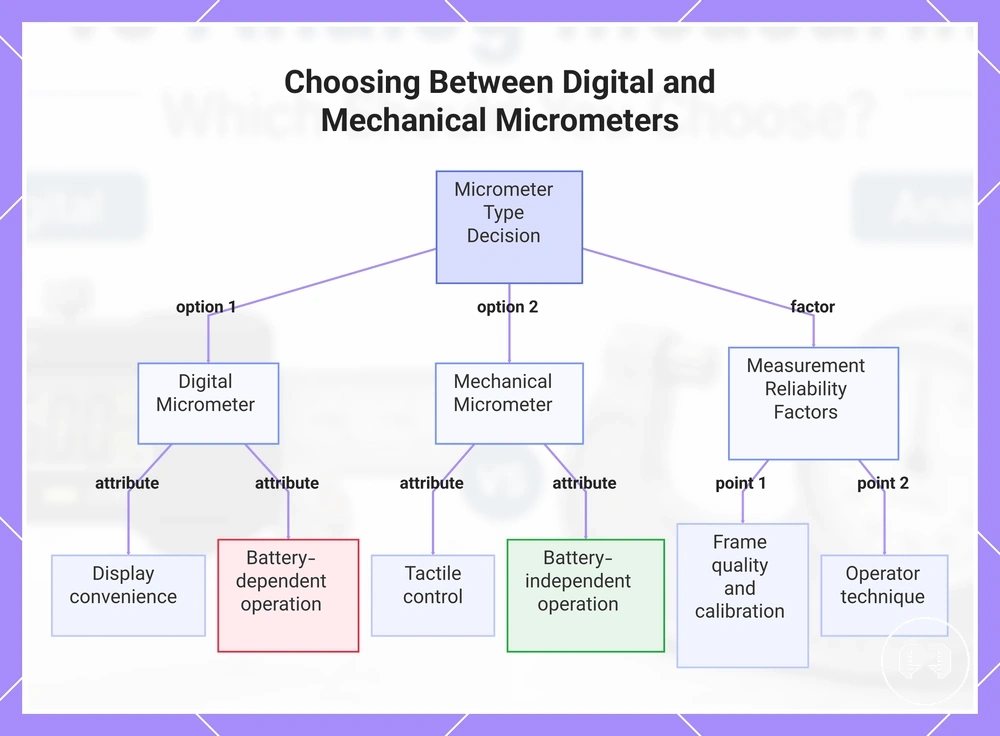
Choosing between a digital micrometer and a mechanical micrometer depends on whether display convenience or tactile control better suits the measurement task. A digital micrometer may make measured values easier to read from the display, while a mechanical micrometer emphasizes spindle feel and battery-independent operation. Neither micrometer type should be assumed to produce better results because frame quality, calibration, and operator technique remain important during high-precision work.
Digital micrometers may suit users who prefer direct value capture, whereas a mechanical micrometer may appeal to users who value tactile control and consistent spindle feel without relying on battery power. Display resolution can improve reading convenience, but reliable measurement still depends on suitable power condition where applicable, proper calibration, controlled measuring force, and careful operator technique.
This chart compares digital and mechanical micrometers, highlighting their key attributes and the common factors that affect measurement reliability.
Cost, features, and long-term value
Long-term value depends on how well a measuring tool matches the workload, ownership conditions, and maintenance expectations rather than on price alone. Digital and analog value should be judged by cost, features, durability, power dependence, calibration expectations, and frequency of use.
Digital convenience may be worth paying for when repeated measurements, direct value capture, or workflow efficiency support daily workshop use. Analog simplicity may be enough when occasional use, battery independence, and straightforward mechanical operation meet the measurement requirement.
The table below compares cost against features, replacement risk, calibration expectations, and frequency of use without making price claims or ranking one tool type as the best choice.
| Ownership factor | Digital tools | Analog tools |
|---|---|---|
| Features | May add display convenience and faster readout support. | Emphasizes analog simplicity with fewer electronic features. |
| Power dependence | Requires suitable power for electronic operation. | Does not rely on battery power. |
| Maintenance and calibration | Calibration remains important, and electronic components may add maintenance burden. | Calibration remains important, while maintenance focuses on mechanical condition. |
| Long-term value | May suit frequent use when digital convenience supports the workload. | May suit occasional use when mechanical reliability is enough. |
Replacement risk and durability should be considered with the tool type rather than separated from the way the tool is used. A feature-rich digital tool may lose value if its added functions are rarely needed, while a simpler analog tool may be more practical when the workload does not require electronic convenience.
Overall ownership value depends on whether the tool’s features, maintenance burden, calibration expectations, and use frequency support the measurement routine over time.
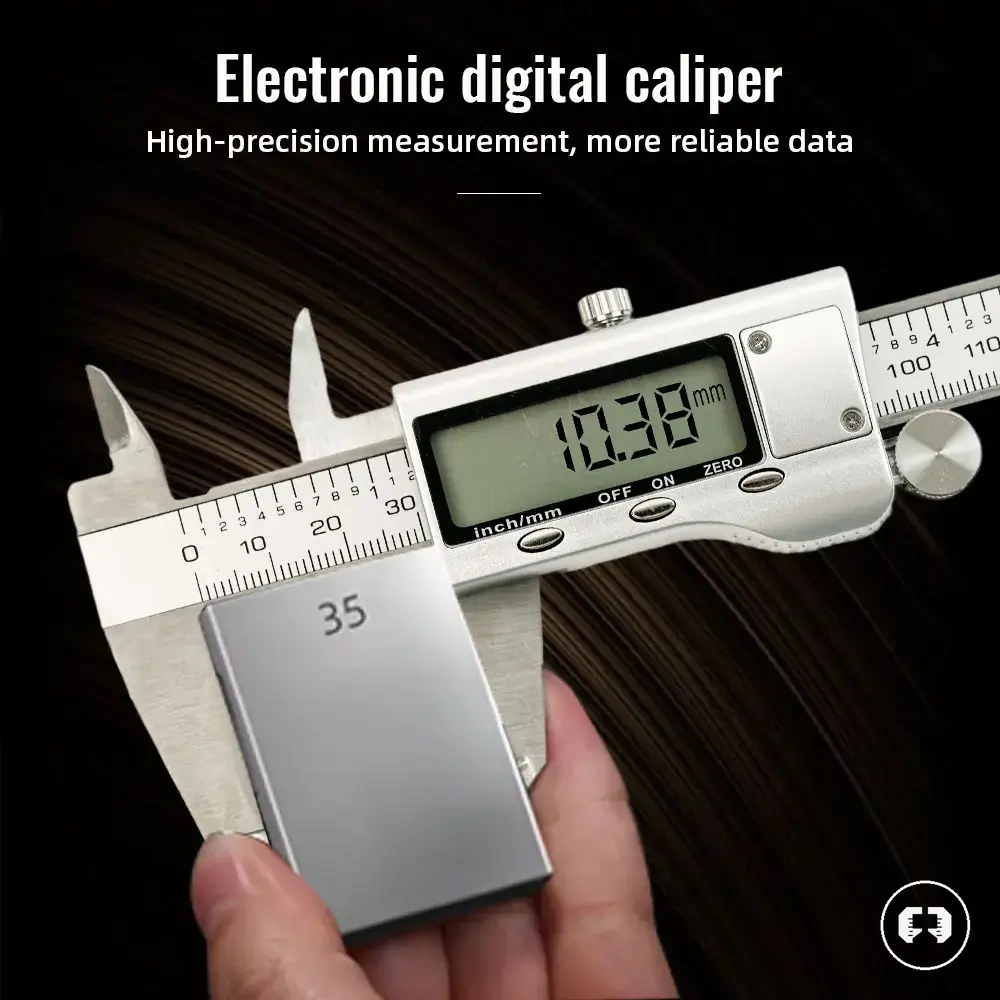
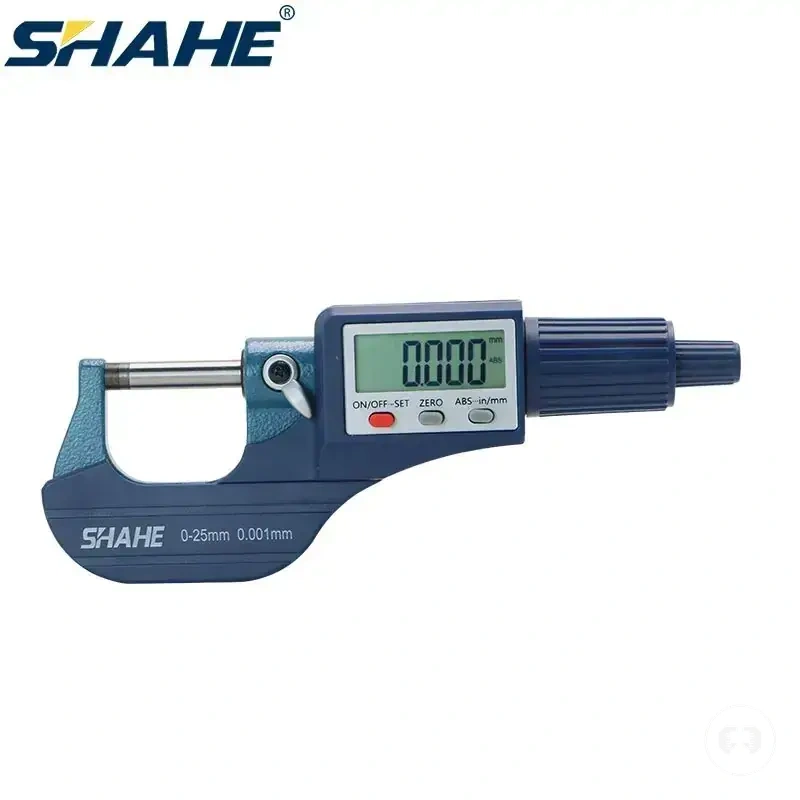
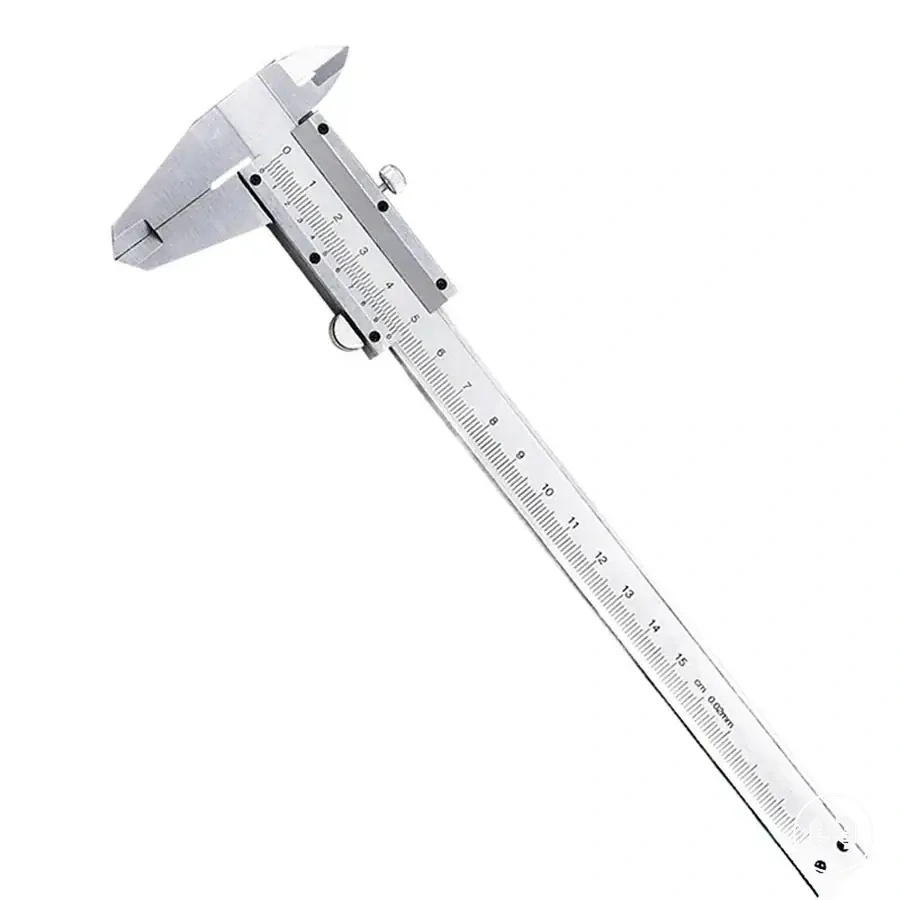
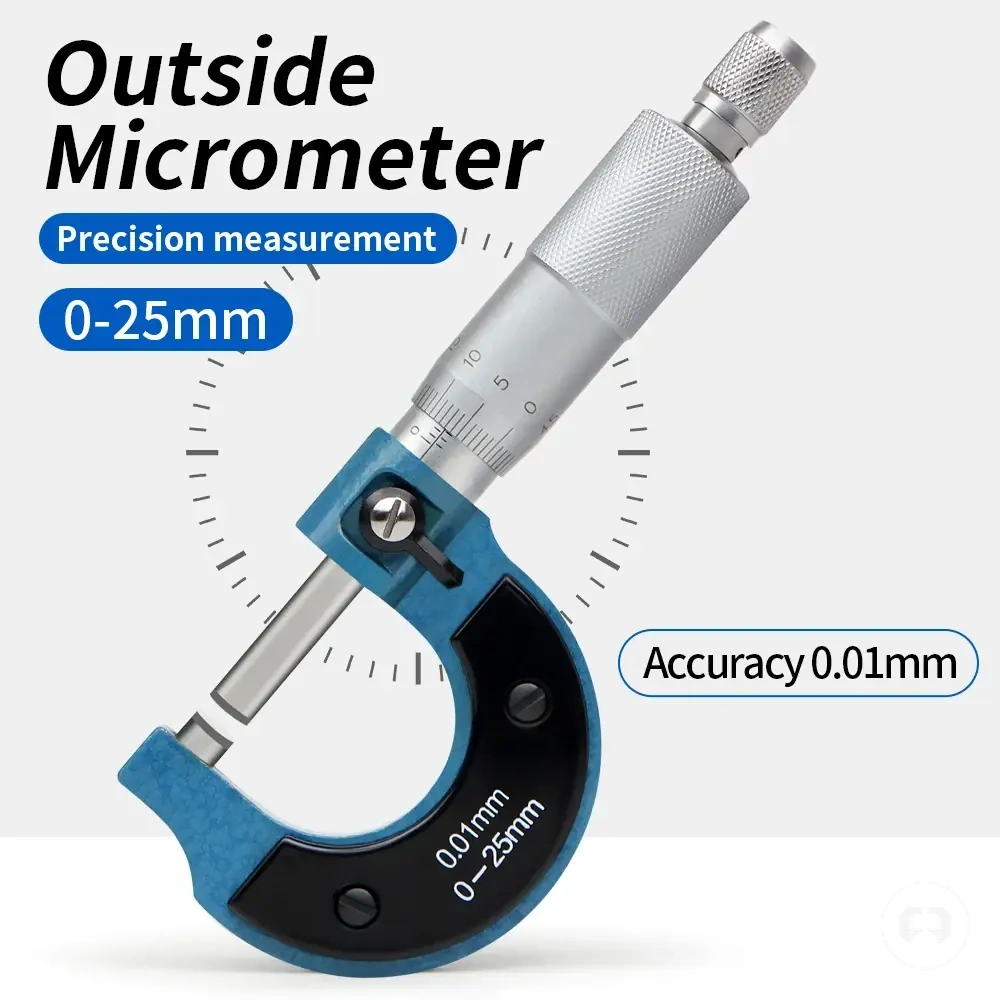
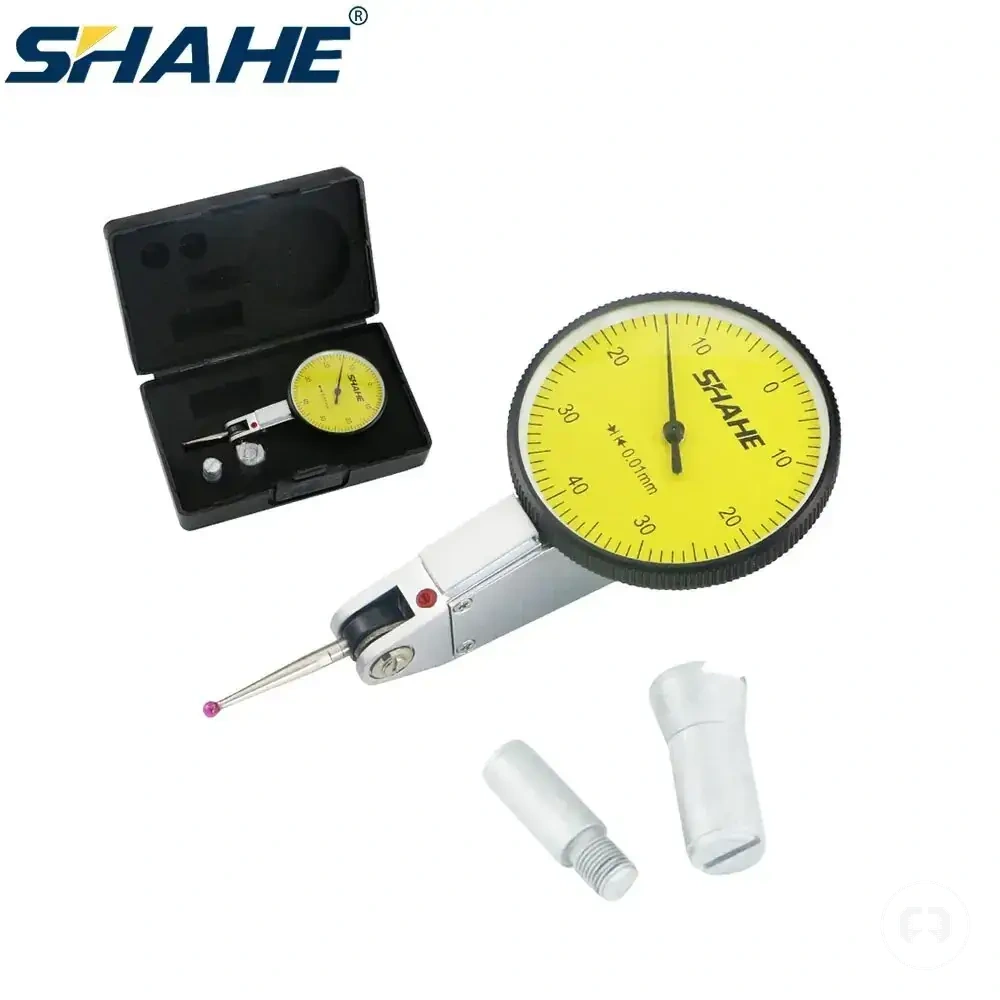
The products below are useful examples for comparing available options. Before buying, check that the compatibility criteria, key features, and product details match your needs.
Choosing digital or analog precision measuring tools by use case
Choosing digital or analog precision measuring tools depends on the use case, measurement task, user skill, environment, and reading preference. Digital convenience may be more useful when reading speed and repeated measurements matter, while analog simplicity may be more useful when power availability, mechanical operation, and reading discipline are priorities.
Beginners may prefer digital tools when the display reduces the learning curve and makes values easier to read. Users who are comfortable with scale interpretation may prefer analog tools when battery independence or a simpler mechanical system better fits the working environment.
| Use case | Selection criterion | Recommended direction |
|---|---|---|
| Beginner use | Reading preference and learning curve | Digital convenience may reduce reading friction. |
| Repeated measurements | Reading speed and workflow rhythm | Digital tools may help when fast value capture supports the task. |
| Field use | Power availability and environment | Analog simplicity may help when battery dependence is inconvenient. |
| Careful tolerance checks | Accuracy need, calibration, and technique | Either system may work when tool quality, calibration, and method fit the task. |
The strongest choice is the tool system that matches the measurement routine rather than the one with the most features. For broader selection criteria beyond this comparison, see choosing precision measuring tools.
Digital tools may suit frequent, repetitive work when direct readout improves speed and reduces interpretation effort. Analog tools may suit occasional use, no-power conditions, or users who prefer mechanical scale control.
Final selection should balance accuracy need, reading speed, power availability, workshop condition, user skill, learning curve, and tolerance checks without assuming one format is universally better.
The products below are useful examples for comparing available options. Before buying, check that the compatibility criteria, key features, and product details match your needs.
Digital tools for fast readings and unit switching
Digital tools are usually the stronger selection when fast readings, unit switching, and low reading friction matter more than battery-independent operation. A clear display can make repeated measurements easier to capture, while unit switching can help when mixed-unit work requires moving between measurement formats without changing tools.
Digital convenience should be treated as a workflow advantage, not an accuracy guarantee. Selection still depends on workload, display clarity, user skill, and whether the measurement task benefits from faster readout or easier interpretation.
- Repeated measurements: Digital tools may support faster readings when the same type of measurement is checked many times.
- Mixed-unit work: Unit switching may reduce conversion friction when the task involves more than one measurement unit.
- Beginner readability: A clear display may lower the learning curve for users who find scale interpretation difficult.
- Low reading friction: Digital tools may be preferable when quick value capture supports the measurement routine.
Analog tools for rugged use and simple reliability
Analog tools may be the stronger selection when rugged use, no-battery operation, and mechanical simplicity are more important than display convenience. They can suit field work, long storage, or users with strong scale-reading confidence, provided calibration, wear, and reading technique remain appropriate for the measurement task.
Simple reliability should be viewed as a condition-based advantage rather than a guarantee. Analog tools can remain practical after storage or in environments where battery replacement is inconvenient, but selection still depends on user skill, storage conditions, calibration discipline, and the amount of mechanical wear.
- No-battery use: Analog tools may suit situations where power availability is limited.
- Field work: Mechanical simplicity may be helpful when battery replacement is inconvenient.
- Scale-reading confidence: Analog tools may fit experienced users who are comfortable interpreting measurement scales.
- Long storage and maintenance: Storage conditions, calibration, and wear should still be checked before relying on measurements.